
Facts can and do change as new evidence comes to light—it’s a core part of what science is all about. As we learn more and more about how the world works, we have to update our existing bodies of knowledge.
This does, however, mean that some information that we learned in the classroom can become outdated within our lifetimes, as members of the r/ask online community recently shared in a viral thread. We’ve collected some of these internet users’ insights about what facts have changed since they learned them in school. Scroll down to read what they had to share.
We got in touch with the author of the viral thread, redditor u/karatass91. They were kind enough to share a few insights on facts changing over time. You’ll find their thoughts as you read on.

#1

“High school’s gonna be the best four years of your life!”
Reader, it was not the best four years of my life

You can’t carry a calculator all day!
#3

Trickle down economics
NPR points out that scientific knowledge is constantly evolving and changing. It’s not just completely new facts that are discovered. Researchers also take new evidence into account and then use it to reexamine what we thought we already knew.
“The key is that scientific conclusions don’t change on a whim. They change in response to new evidence, new analyses, and new arguments—the sorts of things we can publicly agree (or disagree) about, that we can evaluate together. And scientific conclusions are almost always based on induction, not deduction. That is, science involves drawing inferences from premises to conclusion, where the premises can affect the probability of the conclusions but don’t establish them with certainty,” NPR explains why we can trust science despite facts changing.
#4

If you learn well, you`ll get a good job and will have a nice future. Total BS.
#5

My teachers used to say “Video games will make you braindead.” Turns out video games were all about solving puzzles and problem solving and ended up increasing the cognitive abilities and critical thinking skills for children from a young age.
#6

The food pyramid
We was curious to get the OP’s thoughts as to what we could all do to stay up to date with (at least some) of the changes in science. The idea is so that we don’t feel like we’ve fallen too far behind.
“The point here is to find reputable and reliable sources,” redditor u/karatass91 said that this lies at the core of good scientific education.
On top of that, they suggested taking on an even more direct approach to education by “establishing online connections with researchers.” This way, you could be at the cutting edge of science… at least in the areas that interest you the most.
#7

Animals don’t use tools.
#8

Grade school in the US, mid 1970s: We will be converting to the metric system soon.
#9

While I was in college biology our teacher said she was forced to teach us that cell walls were rigid because that’s what the text book said but, she told us, it was not true–the phospho-lipid cell wall had just been discovered. So we learned it wrong and corrected all at the same time.
According to the OP, there probably will never be a point in time when the facts that we know about the world will never change again.
“I don’t think that the facts about the world will stop changing, since our understanding evolves with ongoing research and discoveries,” they told We.
#10

That Christopher Columbus discovered America. Just ask native Americans about this one.
#11

Areas of taste on the human tongue
#12

Gen X here.
We’ll run out of oil by 2000.
The author opened up to us that they never thought that their question would get so much attention on Reddit. “I know it was a good question, but never had such an expectation,” they said.
“I think it went viral because I believe every redditor went to school and they could come up with an interesting answer,” the redditor noted that the topic was something that most of us could deeply relate to.
The reality is that we all have some knowledge blindspots. There are gaps in our knowledge that we’re not even aware of. These can range from misconceptions about common sense things to false interpretations of more complex situations.
The best that any of us can do is to keep an open mind when we come across information that runs counter to our experiences. This means being humble enough to recognize that nobody is perfect, that everyone makes mistakes, and that we might be wrong in some cases. Scientific knowledge is rarely ever stagnant for long.
#13

That your permanent record really does follow You for Life a bunch of Bologna
#14

Nerves can’t regenerate and electron orbitals are circles. Basically, science keeps getting better and I had no idea these had changed for a long time.
#15

That you have to do lots of extra curricular activities, sports, and volunteer work just to get into any colleg. Joke’s on them. I went to college 10 years after high school so none of it mattered.
However, being open-minded does not mean being naive. This doesn’t mean accepting any and every piece of information that comes your way.
As one study from 2021 pointed out, people tend to think that repeated information is more truthful than new information. This is known as the illusory truth effect. To put it simply, the more often we hear a claim, the more we think that it’s true. This means that all people, no matter how educated, can fall prey to everything from fake news to advertisement campaigns.
#16

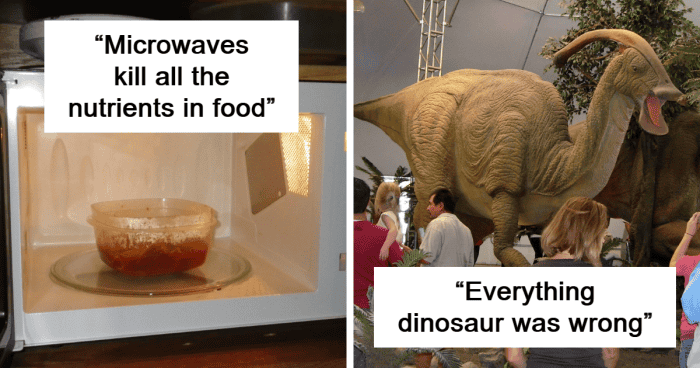
That microwaves kill all the nutrients in food.
#17

A lot of things that we learned about dinosaurs when I was in elementary school turned out to be wrong. We thought they were scaly and reptilian, turns out a lot of them had feathers, and were very brightly colored, and were more like birds in a lot of ways than reptiles. Dinosaurs we thought existed like brontosaurus, turned out to not have actually existed.
Just everything dinosaur. Everything dinosaur was wrong.
#18

That the English language has comprehensive and consistent rules.
What facts from your own school days have you seen get disproven within your lifetimes, dear Pandas? Is there any information from your lessons and lectures that you personally find hard to let go of even when you know it has been updated? We’d like to hear what you think—tell us about it in the comments.
#19

Just about everything they taught about nutrition was a lie… which is kinda insane when you think about it. An entire generation who doesn’t know how food works in your body
#20

Basically any idea promoted by the D.A.R.E campaign
#21

Blood is blue until it is oxidized
#22

Pluto being a planet
#23

1970’s elementary school – Global Cooling was in process. We would be out of oil by the end of the 80’s
#24

Cracking your knuckles will cause arthritis, plus basically everything in history class.
#25

Eating fat causes you to get fat.
#26

Earth had 4 oceans.
The 5th ocean plot twist was revealed to me in my late 30s. I didn’t know, guys!!
Could someone please update Gen X when this stuff happens? There should at least be a weekly memo or something. We are all over here failing easy trivia questions because no one told us that there was a 5th damn ocean. 🤣
#27

I before E except after C.
#28

That breast feeding was a form of contraception
#29

That by 1999 all the landfills would be full and we would have to use the Grand Canyon and valleys for our garbage
#30

That 98% of our genes are unused, a throwback of evolution.