
Most of us see life as a continuous learning process. Whether it’s unexpected situations, new relationships, or foreign countries, we often strive for fresh experiences and exciting adventures by stepping out of our comfort zones. After all, we usually come out stronger and are quite surprised by the things we learn about ourselves and the people around us.
Yet, when it comes to our jobs, we tend to feel a bit intimidated since each career shift leads us to a path full of little mishaps. Luckily, we are not the only ones. It seems that there are plenty of people ready to share their priceless wisdom and teach others about the nooks and crannies of the professional world.
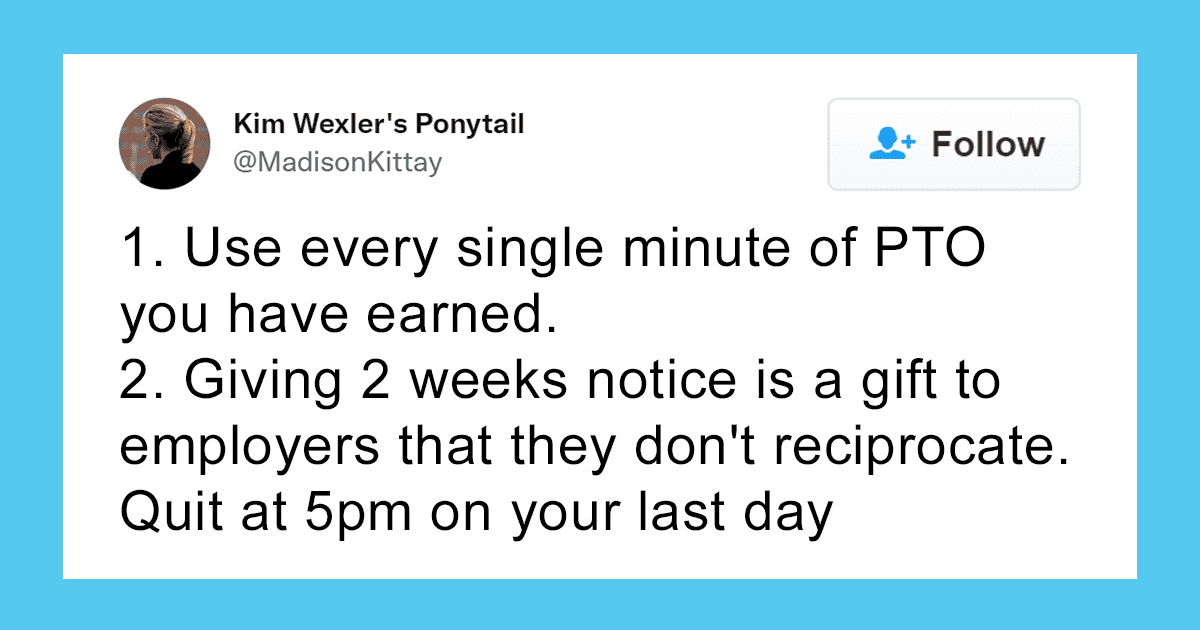
Several months ago, Twitter user angelamavalla asked her followers, “What is the biggest lesson that employment has taught you?” and hundreds of answers started rolling in. So take a look at some of the best tweets We has collected from this thread, upvote the ones you agree with, and be sure to share your own thoughts in the comment section below!

#1


To learn more about employment and the lessons people were not aware of at first, we reached out to Nicola Simpson, a London-based career coach. According to her, the need to strategically manage their career is at the top of the list.
“In the early years, the attention is on the acquisition of skill, knowledge, expertise,” she told We. “Thereafter, people need to be thinking about their long-term career progression, focusing on the selection of roles they both want and NEED to do to advance, and then actively managing their timeline.” Namely “not staying in any one role too long, equally not leaving too soon.”
Sometimes, it can be challenging to understand the companies we work for or the people we work with. “Attention needs to be given to the underlying culture and relationship dynamics within organizations,” Simpson said. “People need to ask themselves, what factors are driving these?”
She explained that making sense of this can be tricky, “but getting to the root drivers helps to create awareness and options for how best to respond.”
#3

#4

#5

The career coach mentioned that reading through others’ experiences online can help people make better decisions in their professional lives. “The stories of others can inspire and also serve as a warning of the many career pitfalls out there,” Simpson added.
“Be confident in your career and your ability to navigate the inevitable challenges that will arise on the way. Get the help of a career coach when needed and have a plan, don’t drift.”
Simpson advised you to remember that all experiences, both good and bad, allow an opportunity for growth and development. “Even the worse professional encounters can be our best educators,” she said.
#6

#7

#8

#9

According to a survey by Gallup, American adults who say they are “completely satisfied” with their jobs have exponentially increased over the past few decades. In 2021, people who were “completely” or “somewhat” satisfied added up to 87 percent of the participants.
However, when they were asked about the amount of on-the-job stress they face every day, only 32 percent of workers said they are “completely satisfied”. The results revealed that people feel more stressed than at the beginning of the pandemic. While workers in the U.S. might be more satisfied with their workplace safety, relationships with coworkers, and job security, there’s still plenty of room for improvement.
#10

#11

#12

If you feel like you’re in a bad situation at work or consistently dread going there, thinking you might have the “can’t get out of bed in the morning” syndrome, your work environment might be toxic. Kristina Leonardi, a nationally recognized career coach, speaker, and writer, told We in a previous interview that if you’re not feeling energized or expansive from your job and cannot use your time in a way that feels useful, you’re not able to lead a fulfilling life.
#13

#14

#15

#16

Whether you think that your job is harming your physical and emotional well-being or you learned something uncomfortable about your company or the people you work with, there are a few things you should do.
“Take an honest assessment of the situation,” Leonardi suggested. “Is it temporary or can it be fixed with a personnel change? Namely, is it just one bad actor or is the tone being set at the highest levels of management?” If you believe that toxic behavior is “initiated, tolerated, or emanated from the top down, there is a good chance that nothing will change, so it’s best to have an exit strategy.”
#17

#18

#19

#20

Sometimes, people want to show that they are good employees by taking on more work and responsibilities while not anticipating that their boss could start exploiting them. Kristina Leonardi mentioned that people who tend to stay at toxic workplaces can sometimes show “a certain lack of self-worth and no boundaries, which others take advantage of.”
Luckily, many workers eventually realize they deserve a healthier environment and kinder treatment. “Once they recognize this and do the work on themselves to get to a better place of inner value and self-esteem, their next situation will improve. Otherwise, they will keep repeating the pattern until they learn (it will be a case of ‘same boss, different name’).”
#21

#22

#23

#24

Leonardi explained that your time and your energy are your most precious resources. “No job situation is perfect but no one should tolerate a toxic environment; everyone has a unique set of skills, talents, and abilities they can apply in some shape or form.” Moreover, people can always find something new “where they can develop, learn, grow, and then use that opportunity to get to the next best place on their career journey,” she concluded.
#25

#26

#27

#28

#29

#30
