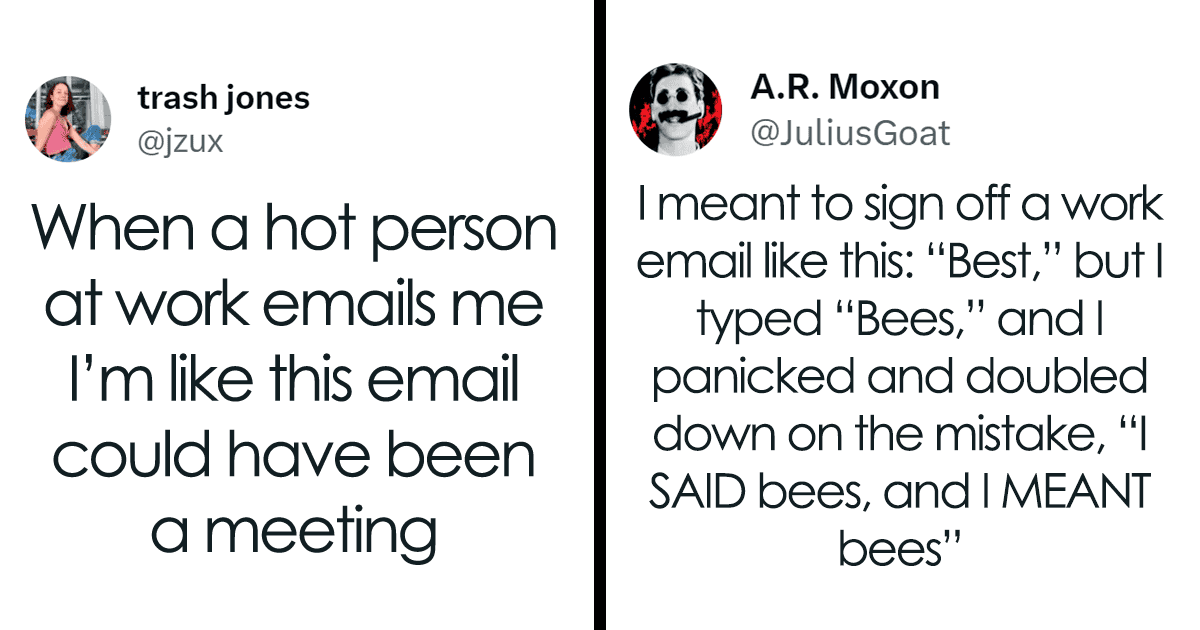

As much as employees would like to see email disappear from their professional lives, it persists like a constant but irregular beat, screwing with their productivity and, in extreme cases, even causing interpretative dance moves to break out in the office, a chaotic ballet of ‘Mark as read’ and ‘Move to trash.’
In an attempt to see how people cope, we turned to X. Turns out, humor is usually the answer. So we put together a collection of hilariously accurate posts depicting the struggles of email correspondence at work.
#1

#2

A survey of 8,000 Americans and Brits revealed that an average employee spends 10 hours and 47 minutes a week drafting emails.
Considering that they send out 112 of them in the same period, that means that workers spend just over five and a half minutes on each one.
The respondents believe their emails are only fully read and understood just 1 out of 3 times (36%).
This might explain why they said that when their email is responded to, it’s common to have their questions not be answered (62%), to be addressed by the wrong name (51%), or to be asked a question they just answered (49%).
#3

#4

#5

However, only the minority shouldn’t be blamed for this; most of the respondents said they are guilty of not reading emails, too.
Over half (57%) admitted that if an email is “too long” — eight or more sentences — they won’t bother reading the whole thing.
With that, employees delete or otherwise don’t read an email based solely on the subject line an average of eight times per day.
But this oftentimes has consequences. 45% of respondents have missed something (like a deadline, a meeting, etc.) because they didn’t read an important email.
#6

#7

#8

#9

Almost half (46%) of respondents feel that email is an outdated form of communication.
Much of their frustration comes from losing emails to the spam or junk folders (53%), or their inbox being clogged with emails that aren’t relevant to them (50%) — others said it’s easy to misconstrue tone over email (47%) and there’s an expectation of staying formal (45%).
#10

#11

#12

#13

According to Keith Spencer, Career Expert atFlexJobs, a platform that helps people find remote, hybrid, and flexible job opportunities, there are a few things we can do to make each other’s lives a little easier.
“Your level of formality is going to depend on the situation,” he told We. “But it’s usually best to keep things a bit more formal when you are communicating with someone outside your organization, like a client or external partner, or when you’re interacting with someone from your same company for the first time.”
#14

#15

#16

Spencer said, “if you’re exchanging emails with someone internally, like another member of your team, you can start out formal but then aim to mirror their communication style and let your tone become somewhat more casual over time, especially as you build a relationship with them.”
“Keep in mind, though, that you can be formal, professional, and friendly all at the same time, you just don’t want your work emails to have the same tone as an email to your best friend,” he highlighted.
#17

#18

#19


#21

#22

#23

#24

#25

#26

#27

#28

#29

#30

#31

#32

#33

#34

#35

#36

#37

#38

#39

#40
