
What is considered normal or socially acceptable is changing all the time. Less than a century ago, doctors were endorsing cigarettes, and people were smoking on planes as casually as we sip juice on flights today. 50 years ago, the world was a very different place, and it’s likely that in another half century, we’ll be saying the same thing.
One aspect of our lives that’s likely to undergo major changes in the coming decades is the workplace. And according to Reddit users, there are plenty of common practicesthey believe will be considered unethical or illegal in the future. Below, we’ve gathered some of their most thoughtful responses, so enjoy reading through and imagining how much better work environments might be for our children and grandchildren.
#1

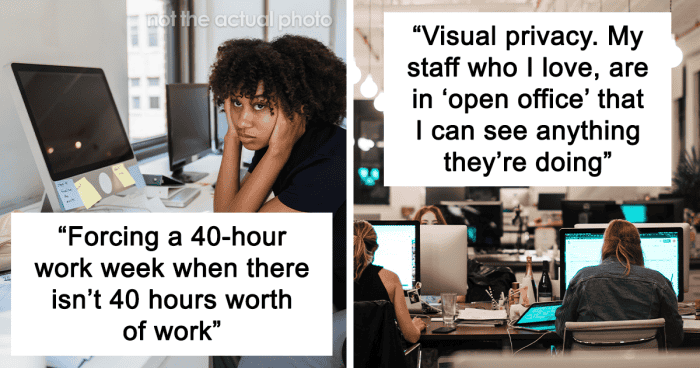
In the US (at least), I think visual privacy. I have an office, so I’m not fussed, but my staff who I love, are in “open office” that I can see anything they’re doing.
I’ve never said it, because I totally don’t give a s**t as long as they finish their work, but it should be illegal for me to be upset/report (I absolutely do not) that they’ve hopped on Facebook for a ten minute break or whatever.
The visual privacy thing causes a lot of stress – worrying about checking your phone at your desk, etc. If there’s a performance issue, there’s a performance issue. If there’s not, there’s not. Did you submit a Draft to me at 1:30pm? Great. Was it in good-enough quality to be workable? Great. Did you spend 15 minutes chatting on Whatsapp chatting about plans this weekend? Great.
It should be illegal for a workplace to stare-at and punish someone for living their life. And it should be unethical to have people in a fishbowl with eyes on them the entire time.
#2

Unpaid internships. Unpaid overtime.
#3

Health insurance tied to employment.
#4

Paying barely above minimum wage for jobs that require a university degree.
#5

Tipping culture being so prevalent, and even required, for some workers to barely make a living wage.
#6

Forcing a 40-hour work week when there isn’t 40 hours worth of work. If it’s a salary position and there’s nothing to do, we should just be able to go home. We work late when there’s deadlines, but when nothing is going on we can’t go home early.
#7

If you do a good job you’re “rewarded” with extra work
#8

Physicians being forced to work 80+ hours/week, 50 weeks/year, for 4-7 years after graduating medical school, while spending precious “free time” studying for board exams, completing tedious research projects, etc.
#9

Paying people different for same/similar jobs and prohibiting people from talking about it with each other.
#10

Little to no maternity/paternity leave.
#11

On call 24/7 365, even on vacation and not being compensated for anything off hours because you are salaried.
This includes the hospital as my child was born, getting written up for not answering my phone when I was under for back surgery (they knew I was having it, but my stand in couldn’t answer something so they said I failed my due diligence, and cost POTENTIAL productivity.
Fun fact, I quit and they refused to take my resignation 3 times. It took 6 weeks for them to finally stop hounding me.
#12

Being expected to work while sick.
Im currently about to start a ten hour shift even though Im ill and have a doctors note. Because I was negative for flu and covid, my work will count the absence against me even with a doctors note.
#13

Attempting to encourage resignation in order to get an employee to quit without having to pay out severance or unemployment benefits.
#14

This probably won’t take 50 years, but forcing people to work in an office when their job does not require it.
#15

Salaried employees working 70-80 hours workweeks.
#16

Working for decades with a skeleton crew where each employee has the tasks of 3 employees and is paid 1/3 the wage, so they need to find a second or third job just to survive.
#17

Probably stretching but I hate when places tell you to come in for an interview for giving a wage estimate. Some situations it makes sense, but if you are running a local business offering people $7.25 US minimum wage whether they are 16 with no experience or the top of the field then you should state it and not waste people’s time.
So many of the “no one wants to work” crowd are trying to offer less than McDonald’s pays for positions that require years of experience, education, or training.
#18
Working in a 110-125 degree fahrenheit factory while watching your coworkers fall out and having the call the ambulance multiple times a week. But don’t worry we got a 20 minute lunch in our 12 hour shift.
#19

Unpaid training. My very first job I worked at a pizza place I “trained” for 2 weeks, never getting paid. At the end of the 2 weeks, I was informed that I would actually be a cook instead of the cashier position I applied and trained for. I left immediately.

A consistent cycle of massive hiring / massive layoffs.
#21

boss giving you infinite amount of work and if you can’t do it then it’s the employee’s fault.
#22

Drug testing for what people do off the clock.
Tying job performance or bonuses to number of OSHA recordables, it just encourages people to hide injuries.
#23

Not having places or times for women to pump
#24

Unpaid overtime is dying out again as we enter a Covid fuelled period of low unemployment – people are not afraid to say ‘no’
If a client tried to get me to work unbillable hours I’d first refuse, and if they insisted would bill the hours on other days
#25
What is accepted/normal is forcing an employee to stand for multiple hours, knowing that they have a documented medical condition that causes them severe pain to stand for hours without end.
What is unethical/illegal in the next 50 years is that with the documented medical condition being known, the managers and supervisors flat out ignoring the ADA accommodation the employee applied for, asking for a short break/chair, and denying the accommodation so the employee has nothing to do but continue to stand in severe pain.
#26

Hopefully being forced to stay at work once all work is done, non living wages
#27
Hopefully, it’s nepotism, but I feel it will only get much worse.
#28

**”Clopening”** as it currently exists in the U.S.
As it stands currently OSHA suggests scheduling a person no sooner than 8 hours of their shift if the shift is 8 hours. Thankfully most companies do follow this suggestion. However, there are two problems 1) it’s a suggestion and not law so some companies may schedule sooner 2) 8 hours sounds great, but it does not account for the fact that commute time back to home, cooking/eating/getting ready for bed, getting ready for the day and commuting back take up time that would be used for getting rest—you could very realistically end up with just 4 hours or rest due to a long commute, having to cook dinner, fulfill parental duties, etc.
#29
Working in shops where the air can be seen because of all the diesel smoke/welding smoke etc.
#30

Rotating shifts and night shifts for less necessary positions. Obviously *some* staff has to be on call or work nights at least occasionally (LEO, healthcare, emergency response) but the average utility worker, for example, should not be required to work rotating shifts. My partner is a wastewater operator and at his previous employer he had to work two weeks of day shifts followed by 2-3 days off, then two weeks of night shifts. This lovely combination ended up giving him unprecedented, unprovoked seizures! (How fun.) His employer wouldn’t work with him to move him to more normal shifts. He went on temporary disability while he couldn’t drive, during which time they hired a replacement to fill his position, forcing him to quit and move to a different company for less pay (luckily on normal, 8-10 hour, day shifts.)