
Folks have to be careful with what and how they practice their freedom of speech online.
No, it’s not because of hate speech or the like—that’s usually tackled by upstanding netizens who shut down trolls pretty quickly.
There’s a much worse fate, and that is that nobody honestly cares because nobody asked. In fact, the level of not caring is so little, there’s an entire online group dedicated to calling out instances of it. If you care, that is.
We also reached out to writer and researcher Julian Stodd to learn more about niche communities online.
#1 Why Do You Bother?

#2 Lemon Cheesecake Is One Of My Favourite Desserts

#3 Well Damn

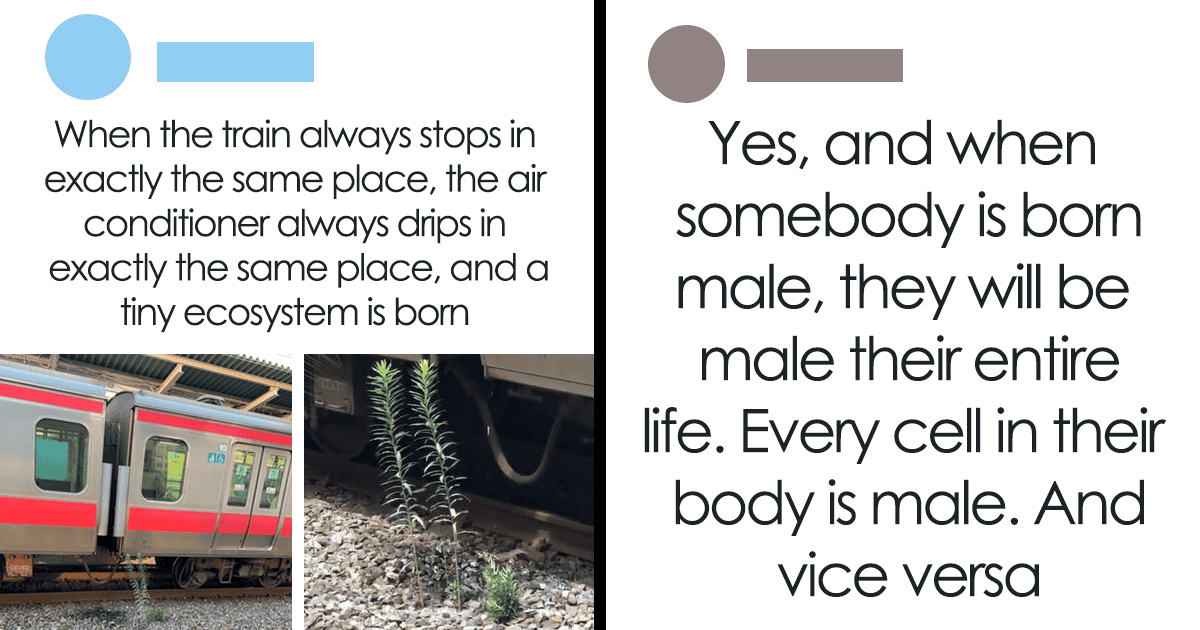
So, there’s this online group called r/NobodyAsked with a supplementary tagline of “Who Cares?” which thrives on people’s unsolicited mouthiness.
It’s a subreddit that’s aimed at pointing out all the times people were never asked anything, yet still explained far too much.
#4 I Remember When I Asked It Was June 4th 1976

#5 Ok, I Didn’t Really Ask Tho

#6 Ok Man

The community was first introduced to Reddit in September of 2017. Since then, it has amassed 377,000 members.
As with most Reddit communities, there are a handful of rules set out, which are pretty much standard, but the fun part is the flairs: there’s SAD, What?, We will ban, and Kind of Asked. I always find those amusing, it sets a great dynamic for the subreddit.
#7 Someone Please Go Get Him

#8 This Belong Here

#9 On A Post About Self Improvement

We reached out to writer, researcher and the captain at Sea Salt Learning, Julian Stodd. Julian helps individuals and organizations alike to get fit for the Social Age, a concept that Julian defined as a map that pinpoints the twelve aspects and factors defining our world in terms of societies, communities and organizations.
#10 On A Video About Winemaking

#11 Why Are People Like This?

#12 Relevant Lotr Question

Julian explains that niche communities online are strong because they redefine what a conversation is: “Spaces like ‘Nobody Asked’ thrive because they change the rules that govern the conversation. In our everyday lives, we may feel that we need to conform to certain ‘ways of being’ to conversational norms.”
“But in these odd corners of the Internet, we can see that it’s OK to just let go—and so we do. You can have conversations that, in your day job, may be frowned upon or laughed at, but here it’s all OK. And sometimes it’s nice to be your authentically weird self.”
#13 I’m Sure This Delivery Driver Means Well, But Wow

#14 A Review On A Recipe

#15 On A Video Of A Guy Pulling A Prank On His Younger Brother

Julian continues: “Of course, there is a downside to this: whilst some of these conversations and communities are fun, others are not. The behavior of other people can create a space where people explore ideas, language, stories that are unpleasant, divisive, and dangerous. It’s the same thing at work: we judge our safety largely on how others behave, which is a way of understanding how riots start.”
#16 What A Sensitive, Well-Thought-Out Reply

#17 Amazon LEGO Set Review

#18 Spotted One While Watching A Video On Self-Defense Shootings…

If you’ve been on the internet, or even just on We, long enough, you’ll know that pretty much anything online can turn into a community, or at the very least a following. Even concepts like apathy—something that Nobody Asked kinda sorta nods at.
“In my work on the Social Age, I describe the ‘rise of community’ as one of the key changes transforming our social reality,” elaborates Julian. “Today we are radically connected, across many different technologies, in many different spaces. There is not ‘reconciliation’ that happens. We can literally be a different ‘self’ in a different ‘community’ every hour of the day.”
#19 Why Bother Even Posting Anything At All?

#20 What Does That Have Anything To Do With This? Lmaooo

#21 On A Post About Looking Like A Pokemon Character

Julian continues: “So, a community could be based on apathy. Indeed, I would be surprised if there are not many such spaces already in existence. Maybe you just turn up, and don’t bother to comment on anything.”
Julian does note a nuance in such communities, though: communities might form with a shared interest, but they can also form in opposition to things. In fact, opposition is an easier force to create (“look at politics”). So, forming a community around, say, apathy, is possible, but forming a counter community that points at the former and says it’s stupid might work out even better.
#22 Congrats Mate

#23 They Were Talking About Overwatch Currency… This Dude Brought It To A Personal Level For No Reason

#24 We Definitely Asked For That

And the impact of such niche communities should not be understated. Julian explains that online communities provide a space to explore ideas, build new meaning, and create new vocabularies.
“I think that they fundamentally change our experience of what it is to be human—in many ways carrying us beyond our legacy boundaries of ‘country’, and notions of ‘citizenship’, which were largely defined by geography, transport technology, and whoever controlled the airwaves,” added Julian. “Today, you can be a member of many different—weird and wonderful—communities around the world, and find real value in them.”
#25 Saw This I. Another Group. Seem To Really Fit Here

#26 Me_irl

#27 Thanks Patti

He continued: “In my research on identity, we see people using these spaces to deliberately separate out and explore aspects of their ‘self’. Of course this can be both a good and a bad thing: without a breadth of opinions, without the opportunity to come up for air, people can get swept into fantasies and narrow perspectives that become toxic or tragic.”
“On the plus side, these niche communities permeate ideas into the wider society, may even form the foundations of the social movements that we need, for greater social justice and accountability—I mean, it’s a long way from a nerdy community on apathy to changing the world, but ideas have a way of spreading…”
“Or maybe there’s a more human and small-scale answer: it can be fun. If it brings a smile to your face, and to one other, then perhaps it’s worth it.”
#28 They Were Talking About Watches…

#29 On A Psychology Video Of The Harry Harlow Monkey Trials

#30 That’s Crazy But Who Asked

You can explore more new ideas, the Social Age, leadership, culture, learning and many other concepts on Julian’s dedicated learning blog and by checking out Sea Salt Learning. You can also give them a follow on X, Facebook and LinkedIn.
But if you feel like scrolling, then We has another article about this very same online group, or you can just visit the group itself.