
Cities may have loads of opportunities and energy but have also been linked to a variety of issues affecting human well-being. Traffic noise, commutes, and pollution all end up affecting our stress levels and even our sleeping habits. City planners have the responsibility to ensure that we don’t all go crazy just living our lives.
As awareness about urban development grows, different online groups have formed that are devoted to showcasing the best designs or shaming the worst. We also reached out to Professor Alan March from the Melbourne School of Design to learn more about urban planning in general. So get comfortable and be sure to upvote your favorite examples. If you want to see more, check out our other article on this topic here.
#1 The Speed Camera Lottery In Stockholm, Sweden

Drive at or under the speed limit and you’ll be entered into a lottery where the prize fund comes from the fines that speeders pay. Average speed reduced from 32 km/h to 25 km/h (a reduction of 22%)
#2 Luminous Pedestrian Crossing In France, When A Person Is Detected The Lights Turn On To Warn The Drivers

#3 It’s Never Too Late To Acknowledge The Reality That Urban Highways Are A Fixable Mistake

We asked Professor Alan March to give a few examples of what are core principles he believes help a city become more livable for its residents. “High enough density to allow services such as schools, parks, infrastructure, healthcare, etc to be provided at an affordable cost. Diverse types of housing and affordable housing. A mix of rent-to-buy, rent, and purchase options, in addition to legal structures that allow co-ownership between non-family members. The ability to move housing according to life circumstances without excessive costs such as stamp duties and other fees.”
“Low energy use, access to a range of green and other recreational spaces. Excellent schools, jobs, transit, and stable representative democracy. Help for poorer, disabled, elderly, and other people with limited life choices. A relatively equal society whereby birth circumstances in terms of location and Socio-Economic Status of parents do not set out one’s life course,” he added as important things for city planners to design for.
#4 Apartment Building With A Park At Its Center, Berlin

#5 Holland, 1982-2020

#6 Planned This Shot For Months Before Coming To The Us, But I Didn’t Expect The Sun To Make The Rails Golden. Sometimes Photography Is Just About Being A Lucky Bastard

As the popularity of walkable cities spreads, many urban areas are making streets smaller, removing parking lots, and expanding bicycle infrastructure and walkways. The most hardline advocates actually want to fully remove most cars from urban areas and replace them with robust and extensive public transportation alternatives. We wanted to know his take on the growing anti-car movement and whether it is too extreme of a solution.
#7 I Dont Know Why, But I Just Love When City Elements Wrap Around Nature Like This. [oc] Photo Taken In Stockholm, Sweden

#8 Comfort Town, An Old Industrial Site In Kyiv Built In Response To Brutalist Soviet Era Apartments Buildings

#9 Edinburgh, Scotland

“The idea of a carless city has merit. Designing the city with few or no cars will mean we emit considerably fewer greenhouse gases and have cheaper and more equitable transport via mass transit and walking (and for the many people who cannot drive for many reasons). We will waste fewer resources on car spaces and freeways, get to know our neighbors better, have lower obesity in children (eg walking to school) and adults, and have fewer accidents and other health impacts from pollution. It will depend on cities being designed properly to achieve this.”
#10 Concrete Sewer Pipes Used As Outdoor Seating

#11 These Public Benches Are Reversible, So You Can Choose To Look At People, Or Boats

#12 Bin For Cyclists In Denmark

Lastly, for some contrast, we were curious to know if he had any examples of cities that made terrible design choices. Professor Alan March specified that Houston was a ‘good’ example of a bad city, due to “environmental degradation, huge inequality of wealth and housing provisions, gated communities for rich.” It also suffers from an overreliance on cars, as over 75% of residents have stated that they need a motor vehicle to go about their daily tasks.
#13 Paris, 9th Arrondissement. These Miniature Gardens Used To Be Car Parking Spaces Until A Few Years Ago. The City Reclaimed Them, And Replanted Them With Fruit Trees And Flowering Shrubs

#14 This Does Put A Smile On My Face

#15 Vienna Gasometers, Gas Storage Tanks First Built In 1896 And Converted Into Mixed-Use Developments Between 1995 And 2001

The abundance of cars on the street creates congestion that had led to Houston having one of the longest average commute times in the United States. This is a result of a comparatively low urban density compared to other US cities, as services, jobs, and public facilities are rarely close together. It’s not all doom and gloom, however, the city authorities are planning to introduce more bicycle infrastructure.
#16 My City, Delhi Is Redesigning Its S**tty Car Centric Good For Nothing Roads, Here’s Half Of A Wide A** Road Reclaimed

#17 “Gion Quarter” Kyoto, Japan

#18 Urban Space Is Complex. But The Math Is Relatively Simple

#19 Heated Sidewalks

#20 Quince Street, Philadelphia. Legalize Narrow Streets!

#21 How Things Would Be Different With A Little Bit Of Rezoning And A Land Value Tax

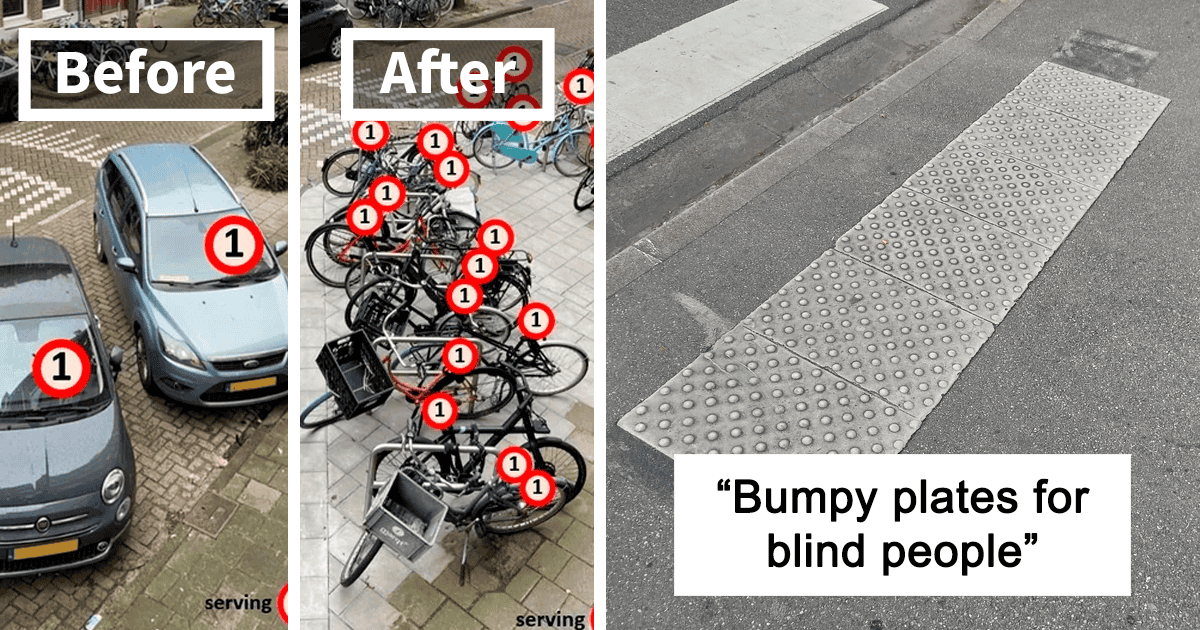
#22 Bumpy Plates For Blind People, Everywhere In France, I Hope It’s The Same For The Other Countries Too

#23 Traffic Light With A Mirror To Allow The Drivers To See The Pedestrians/Cyclists That Are In Their Blind Spots

#24 “Forget The Motor Car And Build Cities For Lovers And Friends.” – Lewis Mumford

#25 There’s A Map Of The District On This Plate In The Street

#26 So We Got The Possibility To Redesign Our Street A Year Ago And We’re Quite Happy With The Result

#27 Car Wash Replaced By Beautiful New Georgian Townhouses During 2017 In Stamford UK

#28 New Mixed Use Flats In Colombes, France Near Paris

#29 Barcelona Now vs. In 1990

#30 A Roundabout In Nantes (France) With An Underground Car Park Entrance

#31 With And Without Trees, What A Difference It Makes

#32 My City Has Been Removing Some Street Parking And Making These “Parklets”. It’s A Much Better Use Of Space

#33 Roundabout With Some Nature In The Middle, France

#34 This Shot I Took Of The Snow Storm In Tokyo Last Week

#35 Aerial Shot Of The Forbidden City, Beijing

#36 World’s Tallest Indoor Waterfall

#37 Professor Carlos Moreno’s Urban Theory Of ’15-Minute City’ – A Concept Where Everyone Has Access To All Facilities And Resources Within A 15-Minute Walk Or Bike Ride

#38 This Is Why We Should Prioritize Infrastructure For Bicycles And Pedestrians Over Infrastructure For Cars

#39 Amsterdam

#40 Green Houses In Berlin

#41 Green Quarantine. Tucuman, Argentina. Photo By Diego Araoz

#42 Rack For Locking Up Skateboards And Scooters

#43 Metal Equipment That Allow Cyclists To Stand Up Straight While Being Stationary Waiting For The Green Light. Spain

#44 One Of The Numerous City Canals In Leipzig, Germany

#45 Before/After, France

#46 Anybody Know Why This Is Designed Like This? (Copenhagen Denmark)

#47 The Outer Battery, Newfoundland, Canada

#48 Planned City – La Plata, Argentina

#49 Unique Types Of Urban Blocks That Are Just Amazing!!

#50 Las Vegas Creatively Getting Around Laws
