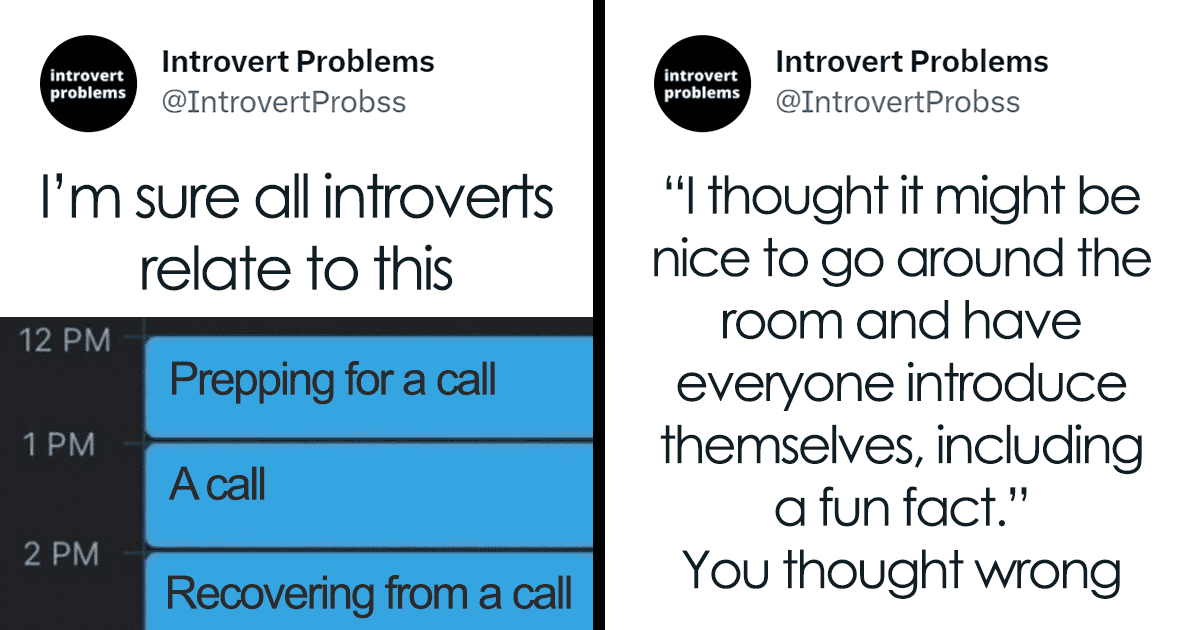

When you’re an introvert, the world is this magical place where the best music is silence and the greatest joy is missing out on things (hence the JOMO abbreviation, which is exactly the opposite of FOMO).
All jokes aside, an introverted life is truly a unique way to experience this world and the socialization aspect of it, so it’s no wonder introversion has become the perfect inspo for funny memes. This Twitter page “Introvert Problems” is one such humorous destination for anyone who wishes they could just stay home and read a book instead.
Below we wrapped up the funniest memes and posts shared on this account which is now followed by 312.2K like-minded followers.
#1

#2

#3

“Introversion is a personality trait which is characterized by a preference for the inner world of one’s mind over the outer world with other people,” Emily Malamet, a clinical psychologist and psychotherapist from Paris Psychology Centre, told We in a previous interview. It turns out that introversion is one of the Big Five dimensions (these are dimensions that define personalities) and is on a continuum that is opposite to extroversion.
“In comparison to extroverts, introverts enjoy subdued and solitary experiences. In addition, introverts typically enjoy one-on-one company, which seems to be more suited to the way their nervous system functions/responds,” she said.
#4

#5

#6

However, it’s important to note that our understanding of introverts and extroverts is often oversimplified and generalized. “There is often a misunderstanding of what introversion and extroversion are in terms of personality, which leads to these oversimplifications or categorial perspectives of these concepts,” Emily said.
Interestingly, people are often neither uniquely introverted nor uniquely extroverted, but may display aspects of both personality traits.
#7

#8

#9

Malamet argues that the majority of the population, for example, needs solitude from time to time in order to replenish their energy. “In addition, often an introvert is often overgeneralized as someone who is shy, but there aren’t many resemblances between introversion and shyness.”
Meanwhile, “those who are shy typically want to engage with others but can be fearful to do so, and they can be very self-conscious. On the other hand, introverts can typically socialize easily, they just prefer to do so either in small groups or, sometimes, not at all.”
#10

#11

#12

We are all born with an innate temperament, and parents/our environment are vitally important to how that temperament is nurtured, Malamet argues.
“However, introverts are (mostly) born that way. It is important to note that the degree to which someone is introverted or extroverted is influenced by genetics and out of all the personality traits that have been studied, introversion/extroversion has shown to be highly hereditary,” she explained.
#13

#14

#15

Nonetheless, there are many environmental factors, including how an individual is brought up and nurtured in their environment, which influence the expression of one’s introversion/extraversion.
“Clinical studies suggest that, unlike with extroverts, the brains of introverts do not react strongly upon viewing new human faces, and in these situations, they have been shown to produce less dopamine (which is a neurotransmitter associated with reward).”
#16

#17

#18

#19


#21

#22

#23

#24

#25

#26

#27

#28

#29

#30
