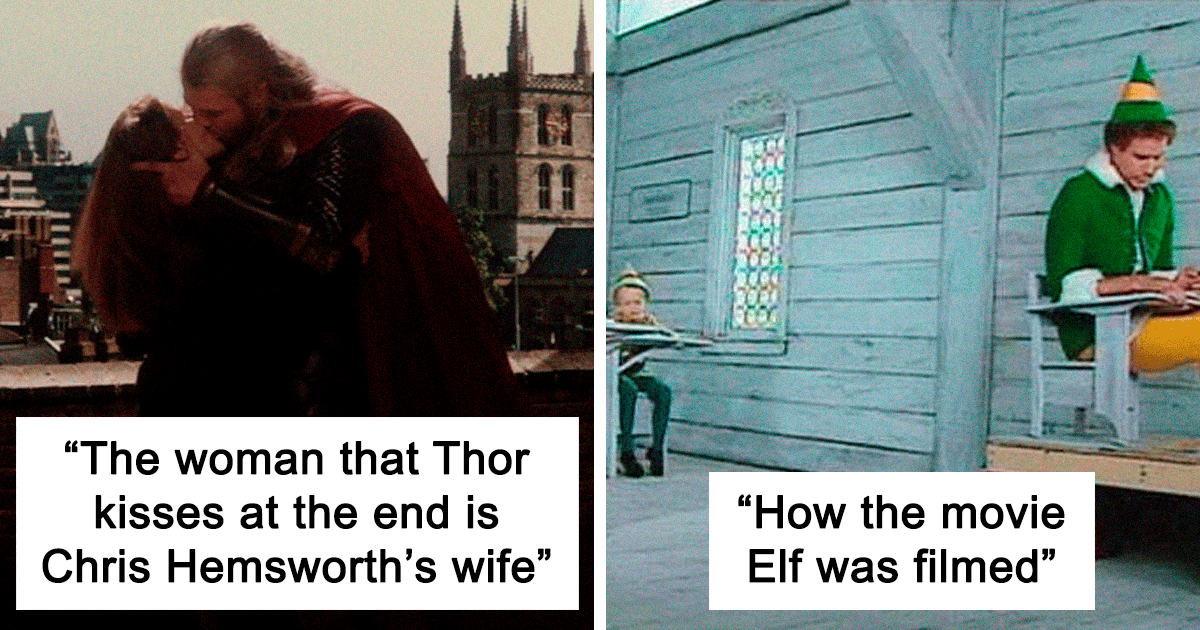

Whether we’re talking about online communities that uncover fascinating movie details or pages that post humorous fake film facts, people on the Internet just can’t seem to get enough of the not-so-obvious references about their favorite motion pictures. Or at least love to hear silly jokes about them.
For our entertainment, there’s a Twitter account called “Movie Details” that is “dedicated to the obscure details and Easter eggs found in movies.”Powered by more than 111K followers, this page is full of hidden gems and strange facts you probably never noticed.
From Back to the Future to Django Unchained, here are some of the most puzzling discoveries movie investigators have found. Continue scrolling and upvote the most surprising ones!
#1

Trying to spot hidden movie details that the creators left for the audience might take a lot of patience and some unexpected luck. Good thing that there are movie-lovers who re-watch the films again and again, just to provide us with a shortcut to the most interesting facts about them.
Let’s show our appreciation for those gifted people who have an exceptionally sharp eye for details. Created in 2017, this Twitter account doesn’t stop surprising us with interesting Easter eggs and tiny hints and messages that they carefully select and bring to our attention. At times, such findings can really change your perception of the whole movie.
Let’s talk about the term “Easter egg”. We know that they can be found in movies, TV shows, and video games. But what exactly are they? Well, to put it simply, they are the hidden jokes and references that the creators sneak into their commercially released products. You can think of them as messages to their eagle-eyed fans.
#2

Ron Cerabona wrote in Canberra Times that the term seems to be coined from the computer-game world when Atari employee Warren Robinett hid his name in one place in the game that would only be revealed to someone who triggered it. “The idea spread and hearing about “Easter eggs” can certainly encourage repeat playing (and movie viewing) although in the Internet age, they’re usually easy to find online.” It also draws a parallel with the Easter egg hunt that we’re all familiar with.
It appears that the film director Alfred Hitchcock used them perhaps more than most. He made cameos in 39 of his films which might be one of the oldest and longest-running series of Easter eggs in films of all time. “Later in his career, he tended to appear early so the audience looking out for him would then focus on the film,” he wrote.
#3

#4

Interestingly, there’s one study that says that synchronized blinking stops viewers from missing the action. It seems that while we are watching a movie, we subconsciously time our blinks so that we wouldn’t miss anything important. Tamani Nakano, the co-author of the study, told NewScientist that the flow of visual information to the brain is halted by up to 450 milliseconds with every blink, and we lose up to 6 seconds of information every minute.
#5

#6

The researchers did an experiment, where volunteers watched a silent comedy with a strong story, a movie with no narrative, and listened to an audiobook. They found that some of the time, individuals will blink in unison while watching the same film: “We all commonly find implicit breaks for blinking while viewing a video story,” Nakano said. “The blinks may form one external manifestation of that, which may provide a window into understanding what people are thinking when they watch a movie.”
#7

#8

#9

Although we might blink at the same time while watching a film, we can definitely overlook some interesting details that others notice. People tend to miss even the most obvious errors, like that in one scene a glass is full, and in the next scene, it isn’t. Inside Science explained, that such moments are called “continuity errors” because they break the audience’s attention and the illusion of realism.
#10

#11

#12

Any good film should try to immerse the audience in the story and make them believe in it. If such mistakes (whether they’re intentional or not) are noticed by the viewer, it makes them confused and not so focused on the story itself. Norman Hollyn, a professor of cinematic arts at the University of Southern California in Los Angeles said that the editor’s job “is to make sure that any breaks in continuity are invisible enough that they do not disturb the audience’s involvement in the story.”
#13

#14

#15

Still, many people miss continuity errors in the films. “There is evidence that people are blind to lots of film edits,” Joseph Magliano, a research psychologist at Northern Illinois University, told Inside Science. “People’s attention is focused on making sense of the things that they are experiencing but in rare circumstances, they will notice errors.”
#16

#17

#18

This makes you feel even more appreciation for the cinema fans who keep on coming up with new surprises about our favorite motion pictures. And don’t think that we forgot how much you enjoy learning about hidden movie details. If you went through this post and still feel the need to know even more facts, check out our previous posts here, here and here.
#19


#21

#22

#23

#24

#25

#26

#27

#28

#29

#30

#31

#32

#33

#34

#35
